• Blog
  • Docs
  • Careers
  • Get Support
  • Contact Sales
DigitalOcean
  • Featured AI Products

    Compute

    Build, deploy, and scale cloud compute resources

    Containers and Images

    Safely store and manage containers and backups

    Managed Databases

    Fully managed resources running popular database engines

    Management and Dev Tools

    Control infrastructure and gather insights

    Networking

    Secure and control traffic to apps

    Security

    Help protect your account and resources with these security features

    Storage

    Store and access any amount of data reliably in the cloud

    Browse all products

  • AI/ML

    CMS

    Data and IoT

    Developer Tools

    Gaming and Media

    Hosting

    Security and Networking

    Startups and SMBs

    Web and App Platforms

    See all solutions

  • Community

    Documentation

    Developer Tools

    Get Involved

    Utilities and Help

  • Become a Partner

    Marketplace

  • Pricing
  • Log in
  • Sign up
  • Log in
  • Sign up

Company

  • About
  • Leadership
  • Blog
  • Careers
  • Customers
  • Partners
  • Referral Program
  • Affiliate Program
  • Press
  • Legal
  • Privacy Policy
  • Security
  • Investor Relations

Products

  • GPU Droplets
  • Bare Metal GPUs
  • Inference Engine
  • Data & Learning
  • Model Library
  • Droplets
  • Kubernetes
  • Functions
  • App Platform
  • Load Balancers
  • Managed Databases
  • Spaces
  • Block Storage
  • Network File Storage
  • API
  • Uptime
  • Cloud Security Posture Management (CSPM)
  • Identity and Access Management (IAM)
  • Cloudways
  • View all Products

Resources

  • Community Tutorials
  • Community Q&A
  • CSS-Tricks
  • Write for DOnations
  • Currents Research
  • DigitalOcean Startups
  • Wavemakers Program
  • Compass Council
  • Open Source
  • Newsletter Signup
  • Marketplace
  • Pricing
  • Pricing Calculator
  • Documentation
  • Release Notes
  • Code of Conduct
  • Shop Swag

Solutions

  • AI Training GPU
  • GPU Inference
  • VPS Hosting
  • Website Hosting
  • VPN
  • Docker Hosting
  • Node.js Hosting
  • Web Mobile Apps
  • WordPress Hosting
  • Virtual Machines
  • View all Solutions

Contact

  • Support
  • Sales
  • Report Abuse
  • System Status
  • Share your ideas

Company

  • About
  • Leadership
  • Blog
  • Careers
  • Customers
  • Partners
  • Referral Program
  • Affiliate Program
  • Press
  • Legal
  • Privacy Policy
  • Security
  • Investor Relations

Products

  • GPU Droplets
  • Bare Metal GPUs
  • Inference Engine
  • Data & Learning
  • Model Library
  • Droplets
  • Kubernetes
  • Functions
  • App Platform
  • Load Balancers
  • Managed Databases
  • Spaces
  • Block Storage
  • Network File Storage
  • API
  • Uptime
  • Cloud Security Posture Management (CSPM)
  • Identity and Access Management (IAM)
  • Cloudways
  • View all Products

Resources

  • Community Tutorials
  • Community Q&A
  • CSS-Tricks
  • Write for DOnations
  • Currents Research
  • DigitalOcean Startups
  • Wavemakers Program
  • Compass Council
  • Open Source
  • Newsletter Signup
  • Marketplace
  • Pricing
  • Pricing Calculator
  • Documentation
  • Release Notes
  • Code of Conduct
  • Shop Swag

Solutions

  • AI Training GPU
  • GPU Inference
  • VPS Hosting
  • Website Hosting
  • VPN
  • Docker Hosting
  • Node.js Hosting
  • Web Mobile Apps
  • WordPress Hosting
  • Virtual Machines
  • View all Solutions

Contact

  • Support
  • Sales
  • Report Abuse
  • System Status
  • Share your ideas
© 2026 DigitalOcean, LLC.Sitemap.
Engineering

Integrate Your Apps With Our API Using OAuth

author

By DigitalOcean

  • Published: July 23, 2014
  • 2 min read
<- Back to blog home

OAuth 2 is now available for applications harnessing the DigitalOcean API, giving developers an easy way to integrate their applications with user accounts. Users can quickly authorize third-party applications with read or read & write access to their DigitalOcean account without exposing personal credentials.

Prior to OAuth support, applications that used the API required users to supply their personal access token, a manual and inconvenient process. The new OAuth flow, available in APIv2, is much better suited for web applications, as users can safely and easily provide access to their accounts through a DigitalOcean authorization request page.
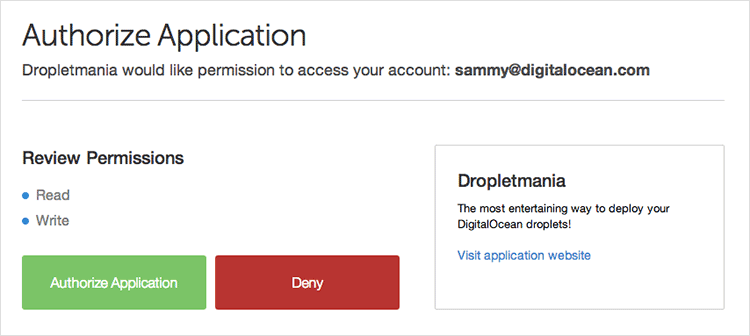
Authorize Application page

Additionally, users can view and revoke account access to authorized applications within the DigitalOcean control panel.

Getting Started

Since we use Ruby internally, we are providing our open source OAuth strategy for the community to use. The omniauth-digitalocean gem is on Github and published to RubyGems. Based on OmniAuth, the widely used Rack-based library for multi-provider authentication, the gem is an easy way to integrate “sign in with DigitalOcean” into Rails and Rack frameworks. We are excited to join the growing list of providers with OmniAuth strategies.

We’ve also developed some community resources to help you get started with OAuth, including a general intro to OAuth 2 and a tutorial on how to use OAuth with DigitalOcean both as a user and as a developer.

As we continue to refine our new API, we always appreciate any feedback on our API v2 Github page. And if you want to let people know about what you’ve built, submit your applications to the DigitalOcean projects page. We’re excited to highlight the great work of the DO community.

About the author

DigitalOcean
DigitalOcean
Author

Share

  • Engineering
  • Product Updates

Start building today

From GPU-powered inference and Kubernetes to managed databases and storage, get everything you need to build, scale, and deploy intelligent applications.
Sign up

Related Articles

Server-Side Tools Are Now Available for DigitalOcean Inference Engine
Product updates

Server-Side Tools Are Now Available for DigitalOcean Inference Engine

Grace Morgan
  • June 17, 2026
  • 3 min read

Read more

The Inference Alpha: Maximizing Frontier Models on AMD
Engineering

The Inference Alpha: Maximizing Frontier Models on AMD

Balaji Varadarajan

  • June 10, 2026
  • 12 min read

Read more

Model Evaluations: Prove Your Routing Policy Actually Works
Product updates

Model Evaluations: Prove Your Routing Policy Actually Works

Sathish Jothikumar

  • June 4, 2026
  • 7 min read

Read more